• Skip to primary navigation
  • Skip to main content
  • Skip to footer

The Jo Cox Foundation HomepageThe Jo Cox Foundation

  • About
    • About us
    • About Jo Cox
    • Ten Years of Jo Cox’s Legacy
    • Our team
    • Our partners
    • Work for us
    • Diversity and inclusion
    • Get in touch
  • Our Work
    • A Safe and Respectful Democracy
      • Jo Cox Civility Commission
        • Summary of recommendations
      • Civility Pledge
      • Joint statement on conduct of political party members
      • Resources to address abuse in politics
    • Stronger Communities
      • Resource library
      • Event calendar
    • Great Get Together
      • Toolkit
      • School resources
      • FAQs
    • More in Common Network
      • Find a group or partnership
    • Our work in West Yorkshire
    • Loneliness Policy Action Group
  • Support Us
    • Become a partner
    • Leave a legacy
    • Online Store
    • Fundraise
      • Challenge events
  • News
  • Donate

Will Fletcher

The Jo Cox Foundation Launches Policy Group to Drive Change on Loneliness

March 6, 2025 by Will Fletcher

Jo Cox famously said, ‘‘I will not live in a country where thousands of people are living lonely lives forgotten by the rest of us.” 

Her tireless work laid the groundwork for a national conversation about loneliness, leading to the appointment of the UK’s first Minister for Loneliness and a cross-government strategy. The Loneliness Policy Action Group will build on this momentum, ensuring that progress continues and that policies are informed by the voices of those with lived experience.

Loneliness affects millions of people across the UK. It doesn’t discriminate by age, background, or circumstance and can have a profound impact on physical and mental health, as well as on community cohesion. Loneliness and social isolation are now widely recognised as a global public health priority. 

With the support of funding from the Astra Foundation, the Loneliness Policy Action Group aims to build on Jo’s legacy by driving meaningful change through collaboration, research, and advocacy. The group brings together a range of organisations from the voluntary sector, including The Campaign to End Loneliness, Age UK, The Marmalade Trust, Together Co, Good Faith Partnership, The Great Friendship Project and Intergenerational England. 

Will Fletcher, Interim CEO of The Jo Cox  Foundation said: 

Loneliness is a shared challenge, but it’s one we can tackle together. Whether you’re a policymaker, community leader, researcher, or passionate individual, we invite you to join us in this vital work. Together, we can create a society where everyone feels valued, connected, and supported. 

Stay tuned for updates as we develop this exciting initiative and work to make Jo’s vision of a more connected, less lonely society a reality. 

Sarah Hale, Foundation Manager at Astra said:

The Astra Foundation is pleased to support the Loneliness Policy Action Group, acknowledging the pivotal and ongoing role of sector collaboration in ensuring loneliness remains a key focus for ministers, policymakers, and commissioners.

If you would like more information about the Loneliness Policy Action Group, please contact Rebecca Pawley, Public Affairs and Policy Manager (Loneliness), via [email protected].

Filed Under: Stronger Communities

Hate crime: the impact on communities in Nottingham, and how to respond

February 27, 2025 by Will Fletcher

The Nottingham Together More In Common Partnership is part of the ever-growing More in Common Network, dedicated to Jo Cox’s message of unity. Nottingham Together has hosted a series of More in Common Community Dialogues since 2023. 

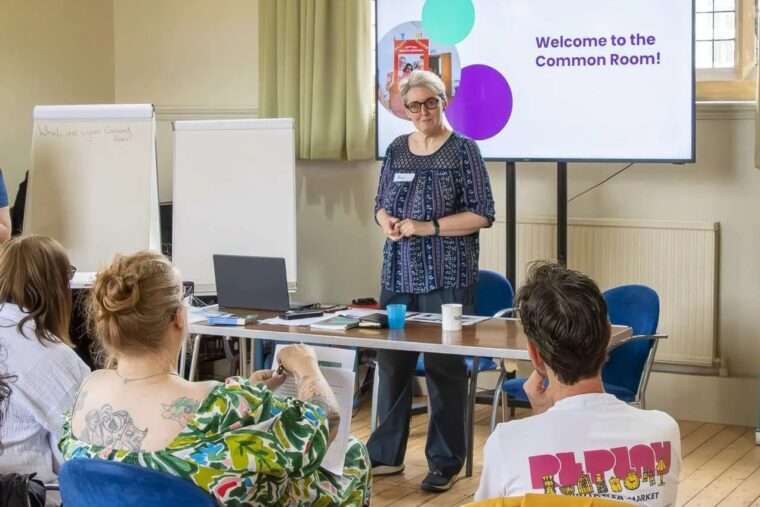
Chief Inspector Karl Thomas, oversees neighbourhood policing in Nottingham’s city centre. He was one of 30 people who took part in a Common Room community dialogue workshop on Hate crime: the impact on communities, and how to respond,  held at the Justice Museum in Nottingham in May 2024.

Karl said:

It was brilliant to have this workshop held in Nottingham city centre. Listening to the speakers talk about their own experiences of hate, and hearing our colleagues talk about the role we can all play in tackling it, was really useful for us in understanding how we can help, as a public service in the county, to increase reporting and reduce this type of crime.

Michael Henry and Shamsher Chohan from Communities Inc facilitated the Common Room workshop which was organised by The Jo Cox Foundation in partnership with Communities Inc, supported by the Renewal Trust. 

The aims of the session were to:

  • understand what increases tensions in communities, 
  • learn what helps prevent hate crime, 
  • share our local knowledge of hate crime, 
  • explore what is working well and what can be improved as a response to hate, 
  • develop ideas for simple things we can do to reduce prejudice and tackle hate crime together.

Nottinghamshire Police gave a presentation on hate crime stats and procedures.

We were invited to have community dialogue on four questions.

  1. What’s happening on the streets?
  2. Who’s being targeted?
  3. What’s working well?
  4. What can be improved?

The discussions identified concerns over some lack of safety for Black people, women, people from LGBT communities and people with learning disabilities in particular. Many communities do not report hate crime due to lack of confidence anything will be done and a reporting system too difficult to bother with. People shared ideas for how to pick up incidents earlier and how to raise awareness of hate crime.

Schools were identified as communities with hate crime incidents and where staff can lack the confidence and knowledge to deal with hate effectively. 

There was an acknowledgement that communication with the Police needs to improve. The new Black Community Advisory Group within the Police was seen as a positive move. 

People expressed the view that charities, community groups and other Third Sector organisations are essential in quelling tensions and supporting victims. The Nottingham Together More In Common Partnership was seen to be working well, and people who were not already members have now joined the Partnership. 

How does hate crime come about?

Shamsher from Communities Inc gave a short presentation on the Hate Crime Pyramid showing how bias leads to prejudice which is what hate crime stems from. She then explained the important role of bystanders/ witnesses as allies for people experiencing hate crime. 

What did people get from the Common Room?

One participant commented afterwards:

I made connections with some partners I had worked with previously and also established some newer connections.  In light of the recent national disorder, it is even more important that these partnerships continue to work together and reach out to the community.

Briony Pietryka, Inclusion and Community Engagement Manager, from the Crown Prosecution Service said that she and other participants across the criminal justice system, voluntary and private sectors were able to share local knowledge of hate crime and develop ideas in relation to working together to build community cohesion and agree practical solutions and actions. 

What did we learn? 

  1. Round table community dialogues unearth local knowledge. This added to and sometimes challenged the picture presented by Police data. It raised questions for the Police and also enabled people to see where they could support each other through shared action. 
  2. We have a better understanding of the way that hate crime emerges from prejudice and bias that is unchallenged.
  3. An in-person Common Room event connected people, increased their knowledge, strengthened collaboration and boosted membership of the local More In Common Partnership. .

The Common Room session was unexpectedly timely, as within 3 months of the event, a series of violent protests took place around the country including in Nottingham. This involved people who were expressing hate, alongside concerns about their communities such as poverty, violence against women and lack of resources. 

It reinforced our learning and the need for more opportunities to have conversations about building trust and bridging divides in communities. 

Check out these resources from Communities Inc

  • Short video of the Common Room workshop on Hate Crime
  • Myth Buster- Asylum Seekers and Refugees
  • Four Tips for Allies – postcard

Further training including Stand by Me programme to build your knowledge, skills and confidence to be an effective ally to people experiencing hate crime.

Join the Nottingham Together More In Common Partnership 

You can find out more about the Nottingham Together More In Common Partnership, including how to join it, on the Nottingham CVS website. 

What’s next?

In 2025 we are holding series 5 of the Common Room programme in Cardiff, Nottingham and Stoke on Trent, and one online, between March and June, working with Communities Inc for one of those. These events will be by invite only, to keep the spaces safe and focussed. However we are always keen to speak with potential collaborators, so if you would like more information or to arrange a chat please email [email protected] 

We are planning our More In Common In Action conference in Manchester in May, an opportunity for More In Common Groups and Partnerships and interested individuals to share learning and ideas for action. Please sign up to the More In Common Newsletter at the bottom of this page if you would like to know what’s coming up.

Filed Under: More in Common Network, Stronger Communities

Bridging Divides – learning from Common Room workshops in 2024 

February 21, 2025 by Will Fletcher

After taking part in our Common Room workshop on Hate Crime led by Communities Inc, one participant commented:

I made connections with some partners I had worked with previously and also established some newer connections.  In light of the recent national disorder, it is even more important that these partnerships continue to work together and reach out to the community.

We couldn’t agree more. This is exactly why we organise Common Room workshops. They provide a friendly, safe space to hear from people with lived or learned experience, connect with others and share ideas for the development of community practice.  

Series 4 of our Common Room workshop programme in 2024 was titled Bridging Divides and Connecting Communities. The aims of these Common Room sessions were to:

  • Provide training and practical advice on topics that relate to bridging divides, countering hate, increasing social connection and promoting community cohesion; 
  • Increase the knowledge and skill set of More In Common Network members and a wider audience including professional, community groups and individuals.

The topics were drawn from the work and concerns of our network of groups and partnerships and based on values that Jo Cox was committed to.  In 2024 we chose topics which were deeper and more sensitive than previous years, due to demand.

On 23rd May in Nottingham with Communities Inc we discussed Hate Crime: the impact on communities in Nottingham, and how to respond. 

Giving feedback, one person wrote:

I got the opportunity to meet other criminal justice and community members with a common interest in relation to tackling hate crime and working to improve community cohesion.

With Mahmooda Qureshi of The Faith and Belief Forum (Walsall) and Gabriella Gay representing Under One Roof community heritage project (Stoke) we explored Social Action in a Zoom session online, on 10th June.

Martin reflected on:

Two exemplary practices for bridging communities and faiths respectively. [I was] struck by Gabriella finding that communities did not have many existing cross-links.

Who Is Your Neighbour? led our session on 10th July in Bradford, in which we talked about conversations that matter:  the ways dialogue can disrupt division.

When discussing key takeaways from the session, Pete said:

Thanks to everyone who showed up. I think it’s ABOUT showing up! I took away [the] power there is in really listening, and equally the satisfaction in being heard by my peers. I talked with several people and felt their passion at the training.

We learned about taking the middle ground: how to respond to anti-minority views, on 18th July in Cardiff with Gareth Harris.

One participant enthused:

Hearing from someone with the knowledge, experience and view points that Gareth has – a training like no other I have done before in terms of the subject matter. It was incredibly useful and important to hear and see different perspectives.

The sessions were unexpectedly timely, as within a week of the final event, a series of violent protests took place around the country including in Nottingham, Leeds, and Stoke (areas of focus in the sessions), instigated by some of the anti-minority groups which Gareth informed us of in the final session. 

What did we learn?

Over the four sessions we learned that building trust and bridging divides in communities relies on offering deep listening beyond immediate expressions of fear and hate, relational approaches, attending to grievances, connecting people over shared concerns to build power and take action together. 

Our learning from each Common Room workshop, with links to resources we found useful, will follow in future blog posts. Come back soon to find out more! 

What’s next?

In 2025 we are holding series 5 of the Common Room programme in Cardiff, Nottingham and Stoke on Trent, and one online, between March and June. These events will be by invite only, to keep the spaces safe and focussed. However we are always keen to speak with potential collaborators, so if you would like more information or to arrange a chat please email [email protected] 

We are planning our More In Common In Action conference in Manchester in May, an opportunity for More In Common Groups and Partnerships and interested individuals to share learning and ideas for action. Please sign up to the More In Common Newsletter at the bottom of this page if you would like to know what’s coming up.

Find out more

You can read more about each of the Common Room workshops that we held in 2024 in the separate blog entries that are linked to below:

  • Hate crime: the impact on communities in Nottingham, and how to respond
  • Bridging Divides through Social Action
  • Troubling conversations in everyday settings
  • Taking the Middle Ground: How to respond to extreme views in your area
Featured Page

More in Common Network

More in common network The More in Common Network is a collection of groups and partnerships across the UK who champion Jo Cox’s powerful ‘more in common’ message to bridge…

Read more

Filed Under: More in Common Network, Stronger Communities Tagged With: connecting communities

More in Common Nottingham: the journey so far

January 30, 2025 by Will Fletcher

The Nottingham Together More In Common Partnership was launched in 2022 and is led by many community and statutory groups across Nottingham including the Renewal Trust,  Nottingham City Council, Nottingham CVS, Communities Inc and more.

The Partnership has delivered three dialogue sessions since its inception. These sessions, led by Communities Inc, bring individuals and organisations together across Nottingham to address and discuss issues affecting the city. People work together to come up with actions on how to improve the situation. Although these conversations are essential, the most important aspect of this approach is connecting and building relationships. The sessions are purposely designed to encourage connections with plenty of conversation and engaging activities! 

The most recent dialogue session took place in October 2024. It included a discussion on the unrest in Nottingham and the UK wide race riots. The focus was on actions to help address the root causes and prevention of future issues. Speakers included Saj Mohammed  (Himmah), Richard Buckwell (Stand up to Racism), Ahmed Peerbhai (Nottingham Council of Mosques) and Nadia Whittome MP for Nottingham East. 

Attendees said: 

‘This [dialogue session] is what you need in Nottingham, we need to make the time to keep connecting so we know what is going on and we can work together…..we need to keep this energy and commitment [experienced in the session] when we walk out of the door today’ 

‘I’ve found out about community groups that I didn’t even know existed which is why it’s so important to meet and talk like this’ 

A snapshot video of the day can be seen here. For a full summary of all the More In Common dialogue sessions, see here. 

The next dialogue session will be in April, if you are local to Nottingham and interested in joining the conversation please contact Beth Hanna at [email protected].

Or if you would like to have a friendly chat about the More In Common Network, please email us at [email protected] and we will be in touch!

Thanks to Communities Inc for the images and the video. 

Filed Under: More in Common Network

Jo Cox Civility Commission: marking the first anniversary of our call to action

January 24, 2025 by Will Fletcher

Abuse and intimidation of our elected representatives – including violence towards them – is one of the biggest threats to our democracy in the UK. Because of this, we launched the Jo Cox Civility Commission in February 2023 to identify implementable solutions to address abuse and to promote civility in our politics.

A year ago today, we launched the Call to Action with our 28 recommendations for how to tackle abuse and intimidation of elected representatives. Today we are publishing a new progress report, outlining where change has taken place in response to our call for action, and highlighting where further action is needed to address abuse in our democracy.

This report shows the significant progress that has already been made, and out of our 28 recommendations, there are seven that have been fully adopted and a further 12 that are in progress to being adopted.

Collaboration and partnership has been key to achieving this progress towards making our politics safer. We are pleased to have forged strong partnerships with many organisations across different sectors, and have worked particularly closely with the Home Office’s Defending Democracy Taskforce, the Local Government Association (LGA), the Parliament Security Department (PSD), the Fawcett Society and Centenary Action.

We are also pleased to have had engagement across the political spectrum to improve respect between and within political parties.

It is clear that there is still a long way to go. The recent elections indicated how common abuse now is and the impact that it is having on the way that people engage with politics.

As well as continuing our work to secure the adoption of all 28 recommendations, it’s important to recognise that these recommendations are themselves only a starting point and only part of the solution to the problem of abuse towards elected representatives.

The recommendations are not designed to be a ‘box ticking exercise’. In fact, some of them are inherently challenging to measure. The point is not for us to congratulate ourselves that our recommendations have been achieved. The aim is for a safer and more inclusive politics, where abuse is no longer normalised as part of participation.

Achieving such large scale culture change and effectively addressing the root causes of abuse and intimidation will take considerable time and effort. 

We cannot make further progress without your support. Please consider supporting our vital campaigning with a donation, so that we can continue our work and move us closer to ending abuse and intimidation in politics. Thank you.

Featured Page

Jo Cox Civility Commission

Abuse and intimidation of our elected representatives – including violence towards them – is one of the biggest threats to our democracy in the UK.  Run by The Jo Cox…

Read more

Filed Under: Respectful Politics

Halton More in Common: community organising and a career in politics

October 22, 2024 by Will Fletcher

Laura is an organiser from the Halton More in Common group, which has been a part of the More in Common Network since its inception. As a working mum and because of the discrimination that she experienced in the workplace because of this, Laura found that she connected with Jo Cox and her message.

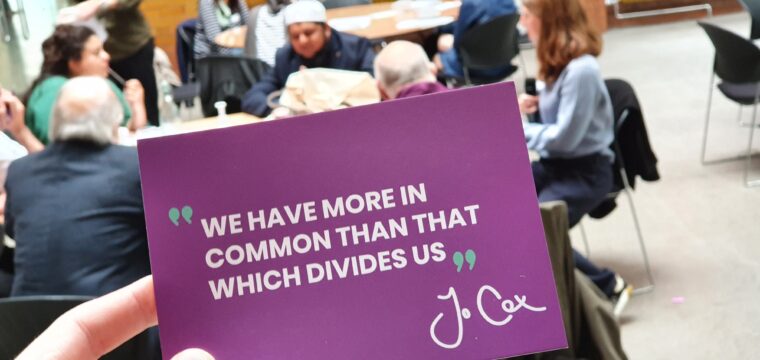
The More in Common Network is a nationwide network of groups and partnerships who are united in Jo Cox’s message that “we have more in common than that which divides us”.  As the network has grown over time, so too has the Halton group. As a network, we are made stronger by the growing confidence and expertise of our groups. Laura has herself had a wealth of experiences that led her not only to form the Halton group, but also led her to a career in politics.

Laura attributes her motivation for celebrating her community to Jo Cox and the outpouring of love and support that followed her death. Particularly moved by the fact that Jo “basically had gone to work and that happened, I felt like it just really stopped me in my tracks.”

In 2017, Laura was motivated by the first Great Get Together to run a community event in Halton.  Along with other passionate members of the community, she organised a free family fun day for the community. Laura says that the event was a massive success because of the fantastic and because “it just captured something in people’s minds because of the story behind it.”

Since this first event More in Common Halton have held many more to engage the community and raise money for causes such as the local food bank. Among these, Women Shall Overcome – an event which focuses on celebrating local women who have faced difficulty and overcome it – has become a regular event put on by Laura and the rest of the team. They also hold annual awards to celebrate and empower the women within their local community.

As a self-proclaimed ‘accidental activist’, Laura found that by volunteering in this way, she was motivated more and more to champion her community. Using social media as a way to spread the word of any events, Laura caught the attention of local councillors who were keen to support the work. Through these connections, Laura learnt of a vacant role in the local Member of Parliament’s office and also went on to become a local councillor herself.

Laura’s journey into politics and continued passion for supporting her community is a testament to the power of the “more in common” message as an instrument for building unity in a community.

Click here to learn more about the More in Common Network or find your local group. And if you’d be interested in setting up a More in Common Group, contact India via [email protected]. We’d love to hear from you and to support you in setting up a group in your area.

Filed Under: More in Common Network

Blog: When does political debate cross the line into abuse and intimidation?

October 3, 2024 by Will Fletcher

By Hannah Phillips
Hannah is The Jo Cox Foundation’s Civility Commission Manager. Hannah is a policy and research professional who has worked on local, national and international levels including at the London Borough of Lambeth Council, the UK House of Commons and the United Nations. In addition to her work at the Foundation, Hannah is a DPhil (PhD) Candidate at the University of Oxford where she examines how the phenomenon of abuse towards elected representatives has been politicised as a policy problem in the UK.

During the course of our work on The Jo Cox Civility Commission we are often asked where the line lies between robust political debate and abuse. We remain clear that a healthy democracy has debate, disagreement and different opinions at its heart, but that doesn’t need to tip over into personal insults and intimidatory behaviour.

In our work, we follow the lead of the Local Government Association who have a clear definition of the meaning of abuse and intimidation. Abuse constitutes physical, verbal or psychological acts that violate an individual’s human rights. Intimidation is defined as behaviour intended or likely to block, influence or deter participation in public debate, or causing alarm of distress that could lead to an individual wanting to withdraw from public life.

Based on these definitions, we are not saying that behaving ‘impolitely’ necessarily constitutes abuse. Politics is full of emotive and sensitive topics that people have strong feelings on. Robust debate and protest is important. In a healthy democracy, people should be able to openly scrutinise and criticise policies and decision-making – whether via social media, by writing to their MP, or attending protests. They should also be allowed to peacefully protest outside Parliament and political offices.

However, behaviour can go too far and quickly veer into abuse and intimidation. We often hear comments that politicians just need to have a ‘thicker skin’. While we agree that disagreements and scrutiny are an essential part of political life, there are certain behaviours that are unacceptable. This includes when criticism is made of the person, rather than the policy, especially if that includes discriminatory language or refers to physical appearance.

The culmination of what might be deemed ‘low-level’ abuse can take a significant toll. While an individual might fire off a single ‘mean Tweet’, the politician might have received hundreds of similar messages day in and day out, and this culmination can feel very intimidatory.

Nearly half (47%) of women candidates avoided discussing controversial topics to keep themselves safe

Research by The Electoral Commission

This abuse is a problem because it impacts participation in democratic life. It causes politicians who are already in office to step down, and is off-putting for those who might otherwise put themselves forward to serve. It also means politicians adjust the issues they speak about for fear of abuse. Recent research by the Electoral Commission showed that nearly half (47%) of women candidates avoided discussing controversial topics to keep themselves safe.

As well as the impact on politicians and would-be politicians, the volume of communications and abuse is felt by staff and families. Politicians’ staff are often the ones who first read the communications sent to politicians. A recent study showed half of MPs’ staff suffer from clinical levels of psychological distress. Families of elected representatives are often the ones at home who might have to deal with intimidatory behaviour.

One of the the challenges with that is often raised in relation to this issue is the role that politicians themselves play in abuse. We strongly believe that elected representatives must set an appropriate tone, and one of our recommendations is that politicians must model good behaviour. But it’s on all of us to change the tone of discourse, and to ensure that we can value robust debate, but centre the need to disagree agreeably.

Find out more about the recommendations of The Jo Cox Civility Commission here.

Featured Page

Jo Cox Civility Commission

Abuse and intimidation of our elected representatives – including violence towards them – is one of the biggest threats to our democracy in the UK.  Run by The Jo Cox…

Read more

Filed Under: Respectful Politics

Jo Cox Way 2024 raises over £20,000 for The Jo Cox Foundation

September 23, 2024 by Will Fletcher

Group shot of riders for the Jo Cox Way 2024 with Kim Leadbeater MBE

85 cyclists have raised over £20,000 for The Jo Cox Foundation after completing an epic five-day ride in memory of Jo Cox.

Now in its ninth year, The Jo Cox Way is a five day cycle from Batley & Spen – Jo’s hometown and constituency – to London. This inspiring ride brings together people from all backgrounds through a love of cycling and a shared goal, while also supporting the work of the Jo Cox Foundation.

All funds raised through the event go to support the Foundation’s work to bring people together. This includes events like our annual Great Get Together. This year’s event marked what would have been Jo’s 50th birthday, and saw people across the UK come together to celebrate their communities.

Sarfraz Mian, one of the organisers of The Jo Cox Way said, ‘This year has seen a spectacularly wonderful Jo Cox Way; we have had the greatest number of participants, the largest age spread, highest ever number of female participants and the take up of all places in just 4 days. The fun and camaraderie amongst the teams of riders was delightful to witness. The organising committee would like to express huge thanks to all of the riders who came together from across the UK to participate in this year’s ride and embraced the More in Common philosophy so beautiful. The riders have been incredible in raising support and record funds for the Jo Cox Foundation. Enormous thanks to everyone that generously donated and also to the amazing sponsors without whose support we could not deliver the event.’

Professor Scarlett McNally, from Eastbourne, raised more than £1,500:

‘I was a first-time rider on the Jo Cox Way 2024 and was amazed by the spirit of ‘we have more in common that that which divides us’. The cycle ride meant five days of conversations as well as the physical and mental challenge. I’m a surgeon and very grateful to many nurses and other colleagues and friends who donated. Four years ago, I had a stem cell transplant for myeloma (blood cancer) and I have written about exercise being a great way of improving health and connecting people. The Jo Cox Foundation supports respect, connections, community and health – the riders benefit as well as the charity.’

Steve Fox, from Leeds, raised £1,400 while riding with an unusual companion:

‘2024 was my third year undertaking The Jo Cox Way. This year I chose to have a friend accompany me, to prove we have more in common than that which divides us. Clyde, recently turned eight years old, accompanied me on a heavy old Post Office bike and was my navigator and cheerleader riding companion. Clyde is a 6kg fluffy gorilla, who sat in the basket at the front of the bike for the whole 293 mile journey. Many passers-by stopped to greet, hug and kiss Clyde and each received a small pack of complimentary love hearts. Clyde and I managed to raise £1400 for the Jo Cox foundation, an achievement which neither of us expected!’

Filed Under: Fundraising

Announcement: senior personnel changes at The Jo Cox Foundation

September 13, 2024 by Will Fletcher

The Trustees of The Jo Cox Foundation are delighted to announce that Rosamund Blomfield-Smith has been appointed as Interim Chair. Rosamund has been on the Board since 2020, and is the Treasurer and the Chair of the Audit Committee. Rosamund will bring her knowledge and experience from 30 years in the City and 20 years in a wide variety of non-executive director and chair roles. Rosamund said “It’s a privilege to step up as Interim Chair. Jo was a greatly-valued friend, and I’m delighted to be able to lead the Board as we continue to do important work in her name”.

In a change to the senior team, after 5 years at the Foundation, CEO Su Moore will be stepping down at the end of the September. Su said “It’s been an absolute honour to work at the Foundation, and to make change every day on issues that Jo was passionate about.”. Will Fletcher, Head of Operations and Finance, will be taking on the role of Interim CEO. Will first joined the Foundation in 2021, and has a breadth of experience in the charity sector, including as Chair of Derbyshire Mind.

Details of the arrangements for the recruitment of a permanent Chair and CEO will be announced in due course.

Find out more about our team and the work we do.

Featured Page

About

The Jo Cox Foundation makes meaningful change on issues that the late Jo Cox MP was passionate about. Our vision is of society underpinned by an enduring belief that “we…

Read more

Filed Under: Operations

  • « Go to Previous Page
  • Page 1
  • Page 2
  • Page 3

Footer

Fundraising Regulator badge with validation link
  • Twitter
  • Facebook
  • Instagram
  • LinkedIn

Contact us

About us

Jobs

Donate

The Jo Cox Foundation is a registered charity (no. 1170836) and registered company (no. 10392667) in England and Wales.
The Jo Cox Foundation © 2026. All Rights Reserved. | Privacy policy