Introduction
One of the objectives of The Jo Cox Foundation’s Stronger Communities work is to nurture strong networks, ensuring that people working to create less lonely, better-connected communities are equipped to do so by increasing their wellbeing, connections, knowledge, skills and confidence.
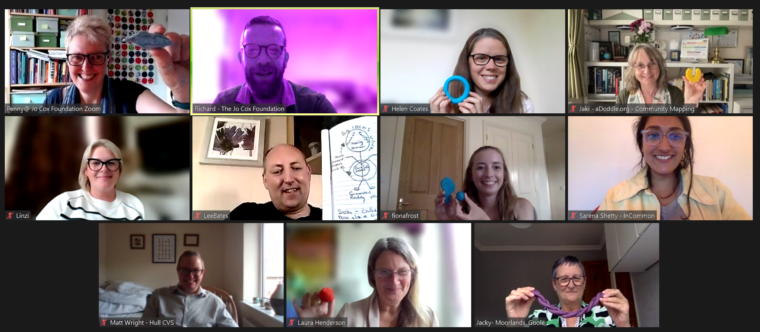
Between July and October 2023, a group of community practitioners came together with us (Penny Vincent and Richard Evans from the Jo Cox Foundation) in six two-hour sessions as a Community of Practice (CoP), which was aimed at working through common challenges and building new relationships. Mindful of financial challenges – and that many practitioners work in small, volunteer-dependent groups and organisations – we made it free to participate. But, heeding the advice of trusted friends, we were also aware of the value of peoples’ time and aimed to make it an experience with really tangible benefits.
This blog is about the impact our Community of Practice had, and the lessons we learned from it.
If you’d like to know more about what a Community of Practice is and how we did it, please contact us.
Impact – joy, wellbeing, connections and working practices
I feel on top of the world – I have definitely been moved on in my thought process where I was stuck for weeks. Thank you everyone for an inspirational evening as usual!
A participant at the end of the second session
I am feeling hugely grateful. Over the last 3 months I have been part of The Jo Cox Foundation’s Community of Practice and it has been a remarkable experience. It has involved coming together virtually with an amazing group of like-minded people to explore issues pertinent to our work (loneliness, social care, homelessness) in doing so gaining shared learning and support. But it has also been a shared space for truly inspiring people to gain support with refocusing on how we perceive the world and the wicked problems we are trying to address. At a time when so many in my sector are suffering with compassion fatigue, unprecedented demands and ever growing financial pressures, this safe space with compassionate and caring peers has been a true sanctuary.
A participant at the end of the final session
The Community of Practice was very successful. Unprompted and genuine quotes like those above felt heartwarming to read; reassuring us that the group didn’t just enjoy the CoP experience (though that was important), but that it might also have made a real positive difference to their work.
To help us understand this impact, our Monitoring and Evaluation Manager talked with the participants a few weeks after the programme ended, asking questions to unearth what might lie behind their glowing feedback.
In one way or another, everyone said the programme felt positive for their wellbeing. This benefit is important, and to provide that in an online space focussed on work challenges, convened in the evenings after long days at work, felt particularly helpful. It was also said that the sessions felt safe; this was crucial in contributing to that improved mental health outcome.
Several people made solid new connections through the CoP. A few people were still in touch regularly and were exploring ways of working together. Good relationships are vital, and working in partnership feels increasingly important as our resources are stretched. Spaces to develop meaningful working relationships that ‘stick’ are not always easy to find.
Some of the group have changed elements of their working practice as a result of activities we worked on together, taking aspects of specific sessions into their work.
As with any piece of work, as well as celebrating success we need to learn and improve. These are the three main lessons we have taken from the programme.
Lesson 1: Balance what we put in with what we get out
Twelve people felt the positive impact of the CoP. But actually, it was ten people when we account for two people having to drop out after one session. At the start, lower numbers of people applied than we’d hoped.
Maybe this is ok; trying to engage too many might drain the deep enriching experience and throw us from being human-centred. A CoP seems to work best with relatively low numbers of people involved – twelve is a fairly typical size.
But the running of a CoP takes time and mental energy: application processes; content design; session delivery; evaluation and monitoring; and lots of communication. There’s constant thinking needed – planning, reflecting and adjusting. A variety of activities keeps people engaged, and working with people whose roles are varied brings a richness of experiences, perspectives and ideas. But this variety adds to the mental gymnastics needed from the organisers – both in-the-moment and in creating the content.
We need to try to increase the benefits of a CoP (the numbers of people benefitting and the depth of impact upon them) to reflect the amount of effort we put in.
We’re exploring a few ideas to try to increase the numbers of people applying for a future programme:
- Avoiding the summer (evenings are bright and it’s holiday season)
- Focussing on a specific theme to increase the ‘this is for me’ feeling at application stage
- Creating incentives (take part in x sessions to receive y)
- Charging (doesn’t have to be a lot to add a sense of value)
Lesson 2: Be flexible and realistic about what people can do
Of our twelve participants, no one managed to make it to all six sessions – and many had to leave sessions early or join late. This, and people’s limited capacity to engage between sessions, suggested we need to be realistic about how much people can do. Even when a CoP complements people’s work well, ultimately it tends to sit alongside it for most people – ‘another thing to do’.
The application and evaluation processes showed us that some people are able to engage best with evening sessions, whilst for some daytime is the only option. Some enjoy two-hour sessions, some need shorter or longer. Some are able to commit to a short series of sessions, others are attracted to a long programme. So flexibility is important.
Perhaps it’s worth building in some expectation of ‘dipping in and out’, and maybe working with a larger pool of people over a longer period could allow for that. Maybe sessions could be run at different times to match differences in working patterns and life demands.
But at the same time, the CoP space must feel safe and consistent. To reap the benefits that come from shared reflective practice trust needs to be built between participants, and between participants and organisers. That’s much harder to do if too many people are coming and going.
We can’t expect too much work between sessions – just the odd email reply, perhaps an extra quick chat. Homework feels like an unfair and unrealistic burden.
But communication from the organisers, clearly and regularly between sessions, is a must to retain people. Our attendance was overall pretty high considering everything, and we believe our communications helped with that.
Lesson 3: Be relational
In our monitoring of how people were responding to the various sessions, we found more reflective sessions were broadly more appreciated than sessions involving the sharing of a tool or imparting of some insight. Action Learning Set sessions for example, during which areas of shared practice were explored without a specific goal in mind, were consistently said to be useful and enjoyable.
Instructional elements are still very helpful but, overall, it feels important to prioritise the human stuff. The activities that allow for more connections and understandings as useful things in themselves, and activities that are good for our mental health – gentle check-ins that allow us to understand where everyone is at, playful energisers that bring us to life, music to welcome people in, and a variety of activities that encourage deep self-reflection, careful listening, and honest curiosity that can lead to new perspectives and ways of working.
Final thoughts
At The Jo Cox Foundation we are taking the impact of the Community of Practice, and the learning we have gathered from running it, as we design future programmes that create and sustain less lonely and better-connected communities where everyone feels they belong. If you would like to chat with us about our Stronger Communities work or anything in this blog, please reach out to us any time.