This is part of a series of conversations with member organisations of the Connection Coalition.
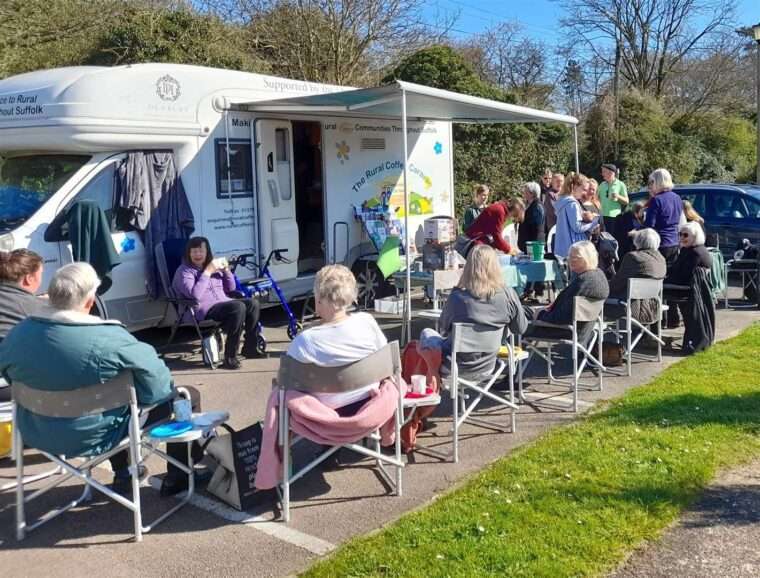
The Rural Coffee Caravan helps rurally isolated people in Suffolk access services and information to improve their lives, health and wellbeing. It also brings people together, empowering and strengthening rural communities. It works to alleviate loneliness and social isolation by providing occasions that engender conversations, leading to people feeling more a part of their community.
Ann Osborn, Rural Coffee Caravan’s CEO, shares her reflections on their work, the challenges of fundraising, and her organisation’s vital fundraising appeal.
Beginning
20 years ago Rev Canon Sally Fogden and a few of her colleagues hit upon the idea of a mobile community café and information centre. They bought a caravan, gathered together some relevant information, made some cakes and drove into rural Suffolk. Their little enterprise was an instant hit, and encouraged by this response, they applied for and received some funding. The Rural Coffee Caravan Information Project was born.
I joined the Rural Coffee Caravan Information Project in 2004 as the part-time project manager. I would drive around Suffolk bringing people together over a coffee, listening to their needs and sharing information that might help them. I was part-time and managed about 15 visits a year. In those 20 years we have grown into a charity with 4 vehicles, 7 staff, and many volunteers making around 400 visits a year.
Connecting
Nowadays I’m less on-the-road and in a more strategic role. I still get out to connect with local people though – I love it, but also it’s important for me to understand local peoples’ issues and stay informed of the up-to-date services and activities available for them. I get out to a few events. We’re very involved in the Big Lunch and have been for a long time. The Great Get Together is also fantastic, and we have Suffolk Day around the same time too, but June is so packed with all these initiatives we can’t do them all!
Small and simple
I feel that in the end, as long as we’re bringing people together it doesn’t matter which initiative we’re part of. And whilst big events have their place, small and simple is best in my view. Often, people don’t think anyone will come to uncomplicated village events so they don’t try. But all that’s needed is a few sandwiches in the street and people will come, appearing like the villagers in Brigadoon!
Survival
The charity needs me to be more strategic nowadays to make sure it stays viable. Fundraising has become a big part of my role. I’m on a mission to get more local businesses involved in supporting our work. I’m very interested in the idea of payroll giving – at the moment 78% of payroll giving from businesses in Suffolk goes to help just 3% of charities, and most of them are based and/or are operating outside the UK. As one way to try to keep local fundraising efforts focussed on local needs, I also founded a small fundraising group with four like-minded friends…
500 Suffolk Reasons
With 500 Suffolk Reasons, the idea is that 500 people each donate £1 a week and are then able to nominate a person or family in need of a helping hand. This could be a front-line worker unable to afford a vital car repair, someone who hasn’t seen their family since the pandemic began but can’t afford the travel, a family who needs particular equipment for a child, or a recently homed person who needs furniture.
Trust
I feel there needs to be more trust from funders. The endless forms, each with unique specific requirements, are so much work – small charities like ours don’t have fundraising teams who can dedicate time to them. And they often ask things like ‘how will you reach XXX people?’ We can’t know the answers to this sort of question – we know from experience and from our understanding of local need that our work will have a huge positive impact, but the reach and benefits are not predictable or prescriptive. Measuring impact isn’t straightforward – we’ve spent years developing warm, relaxing environments for people to connect and surveys under people’s noses won’t work. Some funders – the Lottery and various Trusts – have come to appreciate this and are more flexible in their approach. But in my experience, many still don’t get it.
I’d like to say to funders – let me present to you what we do – if you like it, fund it – and if you don’t, don’t – but please don’t make us jump through endless hoops to try to fit our work with your criteria.
A 20 years celebration?
Celebrating 20 years of our existence doesn’t feel quite right. Of course we’re proud of the service we’ve provided for so long and how we’re managing the charity through such uncertain times, but in an ideal world we wouldn’t have had to do it for 20 years, and there wouldn’t continue to be such a desperate need for us. We’re more ‘marking’ the occasion than celebrating it – and we’re marking it with an appeal.
Appeal
We’ve reached a critical point financially. Although we were fortunate recipients of a National Lottery grant over the next four years, this only represents a third of our income. We still must find £150k each year to survive. So we’re aiming to raise £20k for each of the next 20 years!
Connect
I’d love to hear from other like-minded Connection Coalition members – to share ideas, challenges, or just for mutual support. If you’d like to connect, you can reach me by email: [email protected]